• Products
    • PVC edgebanding
      • PVC edgebanding
      • Decorative PVC edgebands
      • Edgebands to match boards
      • Digitally printed edgebands
    • Veneer edgebanding
      • Veneer edgebands
      • Thick veneer edgebands
      • Decorative veneer edgebands
      • OSB edgebands
      • Edgebanding made of real cork
    • Edgebanding from other materials
      • Edgebands with real metal
      • ABS edgebands
      • Melamine edgebands
      • Edges for lacquering
      • Zero Line edgebands
      • Crystal and 3D effect edgebands (PMMA)
    • Screw covers
    • Other products
      • Spliced veneer faces
      • Special veneer: waterproof and extraflexible
      • Veneer Bundles
      • Veneer rolls to cover moldings
      • Products for DIY stores
      • Veneer rolls for warehouses
  • News
    • Articles
    • Homologations
    • New products
    • Inspiration & projects
  • About us
    • About us
    • Join the team
  • Contact
  • Products
    • PVC edgebanding
      • PVC edgebanding
      • Decorative PVC edgebands
      • Edgebands to match boards
      • Digitally printed edgebands
    • Veneer edgebanding
      • Veneer edgebands
      • Thick veneer edgebands
      • Decorative veneer edgebands
      • OSB edgebands
      • Edgebanding made of real cork
    • Edgebanding from other materials
      • Edgebands with real metal
      • ABS edgebands
      • Melamine edgebands
      • Edges for lacquering
      • Zero Line edgebands
      • Crystal and 3D effect edgebands (PMMA)
    • Screw covers
    • Other products
      • Spliced veneer faces
      • Special veneer: waterproof and extraflexible
      • Veneer Bundles
      • Veneer rolls to cover moldings
      • Products for DIY stores
      • Veneer rolls for warehouses
  • News
    • Articles
    • Homologations
    • New products
    • Inspiration & projects
  • About us
    • About us
    • Join the team
  • Contact
  • Swatches
  • 3D Customizer
  • Equivalences
  • En
    • Es
    • Fr
  • Swatches
  • 3D Customizer
  • Equivalences
  • En
    • Es
    • Fr
  • Products
    • PVC edgebanding
      • PVC edgebanding
      • Matching edges by board manufacturer
      • Decorative PVC edges
      • Digital printing on edgebands
    • Veneer products
      • Veneer edgebanding
      • Thick Veneer edgebanding
      • Decorative veneer edgebands
      • OSB edgeband
      • Edgebanding made of real cork
    • Edges of other materials
      • Edge with external aluminium
      • ABS edges
      • Melamine edgebanding
      • Edges for lacquering
      • Edgebanding Zero Line
      • Crystal and 3D effect edgebands (PMMA)
    • Screw covers
    • Other products
      • Products for DIY stores
      • Veneer Bundles
      • Wood veneer: waterproof and extraflexible
      • Spliced veneer faces
      • Veneer rolls for profile wrapping
      • Veneer rolls for retail stores
  • News
    • Articles
    • Homologations
    • New products
    • Inspiration & projects
  • About us
    • About us
    • Join the team
  • Contact
  • Swatches
  • Simulator
  • Equivalences
  • En
    • Es
    • Fr
  • Products
    • PVC edgebanding
      • PVC edgebanding
      • Matching edges by board manufacturer
      • Decorative PVC edges
      • Digital printing on edgebands
    • Veneer products
      • Veneer edgebanding
      • Thick Veneer edgebanding
      • Decorative veneer edgebands
      • OSB edgeband
      • Edgebanding made of real cork
    • Edges of other materials
      • Edge with external aluminium
      • ABS edges
      • Melamine edgebanding
      • Edges for lacquering
      • Edgebanding Zero Line
      • Crystal and 3D effect edgebands (PMMA)
    • Screw covers
    • Other products
      • Products for DIY stores
      • Veneer Bundles
      • Wood veneer: waterproof and extraflexible
      • Spliced veneer faces
      • Veneer rolls for profile wrapping
      • Veneer rolls for retail stores
  • News
    • Articles
    • Homologations
    • New products
    • Inspiration & projects
  • About us
    • About us
    • Join the team
  • Contact
  • Swatches
  • Simulator
  • Equivalences
  • En
    • Es
    • Fr
Products / Uncaegorized / PVC edgebanding

PVC edgebanding

0,4 - 2

Combine in the virtual customizer

With a stock of over 2,700 references, we can match the majority of melamine boards presently on the market.

The properties of PVC make it a valuable raw material for edgebanding production. Additionally, it is widely used in other applications within the furniture industry.

  • We produce PVC edgebands to match the boards of the main manufacturers in the market.
  • Our customers can get the edgebands at the same time they purchase the melamine.
  • We offer an equivalence finder where you can quickly find the ideal PVC edging for your melamine board.
  • Use our 3D customizer to create thousands of decorative edgebanding combinations.

Do you want to know more about this product?

CONTACT US
SWATCHES

Learn more about this product

Textures and embossings

textures

NH5_5882

Following the latest trends in surfaces, we can offer different pores on ABS edgebands. These textures reproduce the same finish structures as the actual melamines.

The result is a better integration of board and edge.

See all available textures
Copy process

copy

Our samples and homologation department will provide you the edge-band samples suitable for the melamine you require. The objective of this equipment is that our customers can have the edgebanding at the same time they buy the melamine.

. ‎

Vein

We choose the printing roller to develop and copy the vein of the design.

Tone

Matching the edgebanding with the melamine under daylight D65. .

Embossing

To reproduce the same finish structures of the actual melamines we match the embossing.

Copia-del-poro

Gloss

We match the gloss of the melamine board, to ensure homogeneity within board and edge.

Profile tone

The profile tone to ensure that the inner tone, when trimmed, matches the melamine surface to be copied.

Elección-tono-interior

Printing

The definition and printing have to be in accordance to the paper surface to be copied (matched).

Varnish resistance

The resistance of the varnished surface has to be adequate to the use and normal wear of the furniture.

Cutting test

The adherence of the surface varnish by means of Cutting Test.

Adherence

The application of primer to the base of the edge , to ensure an efficient adherence of the edging.

Adherencia
Manufacturing process

manufacture

The manufacturing of calender PVC is basically composed of:

1- SHEET FORMATION: Several chemical components in a solid state (including PVC resins), exposed to high temperatures are melted, mixed, and by means of a DIE (nozzle) and rollers (cylinders), a sheet (to the desired thickness and width) is formed.

2- WOOD DESIGNS: If the sheet simulates a wood design, the exterior surface is printed by means of printing rollers (cylinders), imitating the desired wood grain. Different types of rollers (cylinders) to simulate different wood grains are available. Several can be used at the same time.

3- EMBOSSING: If a embossing is needed, hot rollers (cylinders) are used for the purpose.

4- PRIMER: Afterwards, a primer (for adherence purpose) is applied to the base in order to enable proper bonding of the PVC sheet with the thermo-fused glues (hot-melts) used in edge-banding machines.

5- VARNISH: To ensure protection to the dye of the wood grain designs, a transparent varnish coating is applied to the edge-band.

Diameters and sizes

formats

Material: PVC

Widths: from 5 mm to 140 mm.

Thicknesses: from 0.4 mm to 2 mm.

Roll dimensions: lengths, diameters and sizes according to edge thickness.

Cantos-de-PVC-dimensiones-rollos-ES
Download dimension table
Download illustrative image
Advantages and disadvantage

advantages

What are the advantages and inconvenients of PVC edges in comparison to melamine edges ?

Advantages


Being a plastic it is flexible and easy to work with.


When applied flush to a board, being a plastic, it is easily trimmed and remains well adjusted to the board without splintering.


During the edging process and a defective item has to be re-edged, it is easily removed. Simply pulling the edge to peel it off the board, making the use of heat, or tool, unnecessary for this purpose. Whereas, for other types of edges, heat has to be applied to the edgeband in order to soften the glue and afterwards gently pull the edgeband to unglue it (time consuming process). ‎ ‎


During handling and storing operations of the finished product in a factory, from time to time the edges are banged. If the edges are of PVC, they won’t break, as the material will absorb impacts and will only slightly “cave in”. This characteristic also applies to furniture displayed in a shop or at home. This is an effective sales argument for manufacturer and retail stores. ‎ ‎


The standard thickness (0,4 mm) is superior to the thickness of melamine or paper edges. Therefore efficiently covering a chipboard panel and concealing any imperfection. By using PVC we can increase the thickness as required by the customer. Thus conferring a sturdier aspect to the edged items and also concealing any hollow particles of the chipboard. This is impossible to accomplish with melamine edges.


The use of a good adhesive backing on the PVC guarantees a perfect bonding of the edge to the board. Does not react to variations in humidity.


A well-made PVC base is a PVC base with the right shade. When flush with the board, the colour inside the plastic is the same as the surface of the board. On the single-layer edge, for example, you can see the difference.

Inconvenients


The melamine edges are made of the same paper as the board. But on the PVC edge, when printing with different rollers, the veins of the PVC do not match those of the surface. Therefore, the appearance may approximate but never be identical to the board. This can lead to problems, because some customers believe that the copy on the PVC edgebanding will be identical to the board and this is never the case.


Temperature fluctuations affect negatively PVC. In cold weather it hardens, which can cause splintering and profile deformation. In hot weather it softens, which can cause marks of the chipboard. Nevertheless, the formulas employed confer a high degree of stability of this product against these temperature changes to permit a satisfactory edging process. Logically, if the customer’s premises are properly equipped, this problem will be nonexistent. ‎


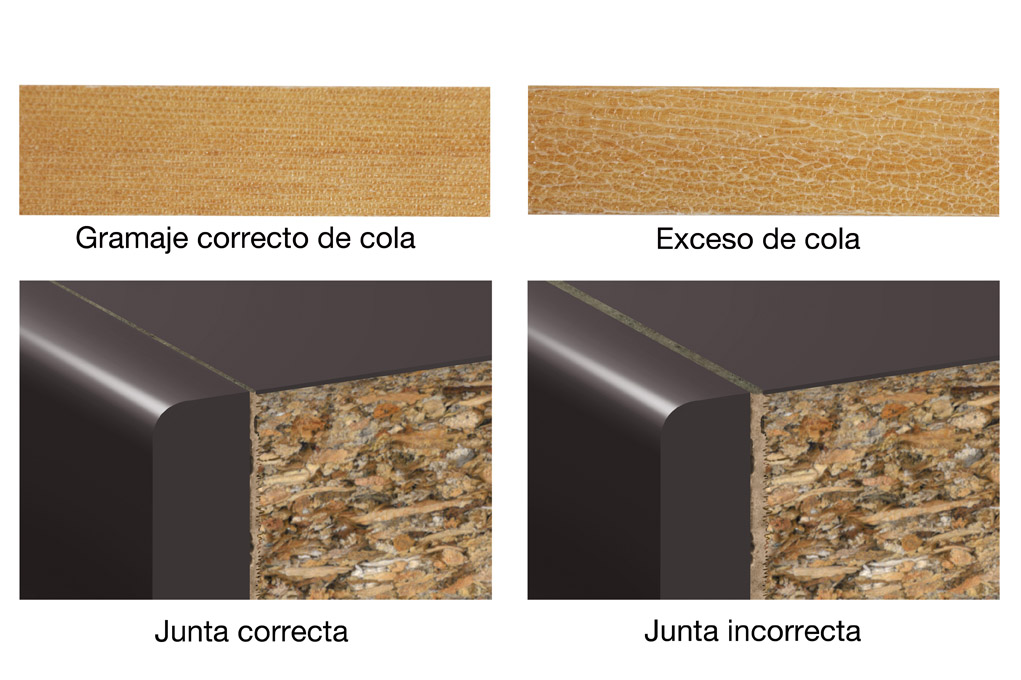
A faulty application of adhesive agent can cause severe bonding problems. If insufficient, it will not bond properly. If excessive, it can split (some of the glue will remain on the edge, while the rest will remain on the board). ‎


From one production to another, there can be differences in color and gloss, mostly on limited productions. The same applies for melamine, the difference being that the paper production for melamine edges are much superior, thus limiting this problem. ‎ ‎


It is inadequate for soft-forming. To apply the soft-forming, the machines will firstly apply the hot melt glue to the edge. If it is a PVC edge, this one will soften to the heat and its application will be most difficult.


For pre-glued edges, which are applied with an iron or hot air funnels, PVC edges are more delicates than melamine edges, due to its behavior to heat. ‎

Technical datasheet

technical

Download product data sheet

All our wood products come from sustainably managed forests. Check our FSC declaration here.

Be inspired!

Visit our Pinterest and discover new decorative ideas. Enter our Pinterest and discover new ideas to decorate your melamine boards.

Finishes

Hot Melt Pre-Glued

A coat of thermofused glue can be applied to the backside of the edge. This glue will melt at 180º.

This glue will melt at 180º. In this way, with a simple hot-air edgebander, or even with an iron, we can adhere a pre-glued PVC edge to the edge of a board.

Thermofused edge banding uses heat to bond the edge band to the board. This proportion being the adequate to ensure a flawless bonding, avoiding any excess of glue at the joint between the board and the edge-band (glue line). At the same time, there is no excess glue in the joint between the edge and the board (glue line).

Our standard glue has a softening temperature of 85-90 degrees. The softening point of our glue is 85 – 90º C (temperature at which the glue will begin to melt).

PVC softens at 60 degrees and above. Therefore, special care must be taken to reactivate the glue and not to damage the PVC edge.

Hot Melt Pre-Glued

Peel and stick

For PVC edges, we can apply a self-adhesive glue to the back of the edge.

We protect it with siliconised paper for its preservation.

By simply removing the paper and pressing manually, we can adhere our PVC edgebanding to various surfaces (chipboard, MDF, solid wood, etc.).

Bond strength tests.

Peel and stick

Protective film

We can apply, on the outside of the PVC edge, a low-adhesive protective plastic.

This option makes sense:

  1. To avoid staining the edge when coating the surface of the workpiece, whether by spray, roller or roller. Once the piece is finished, the plastic film is removed from the edge.
  2. In order not to damage the surface of the edge in case of delicate surfaces, such as high gloss (90 gloss).

The plastic covers the entire edge.

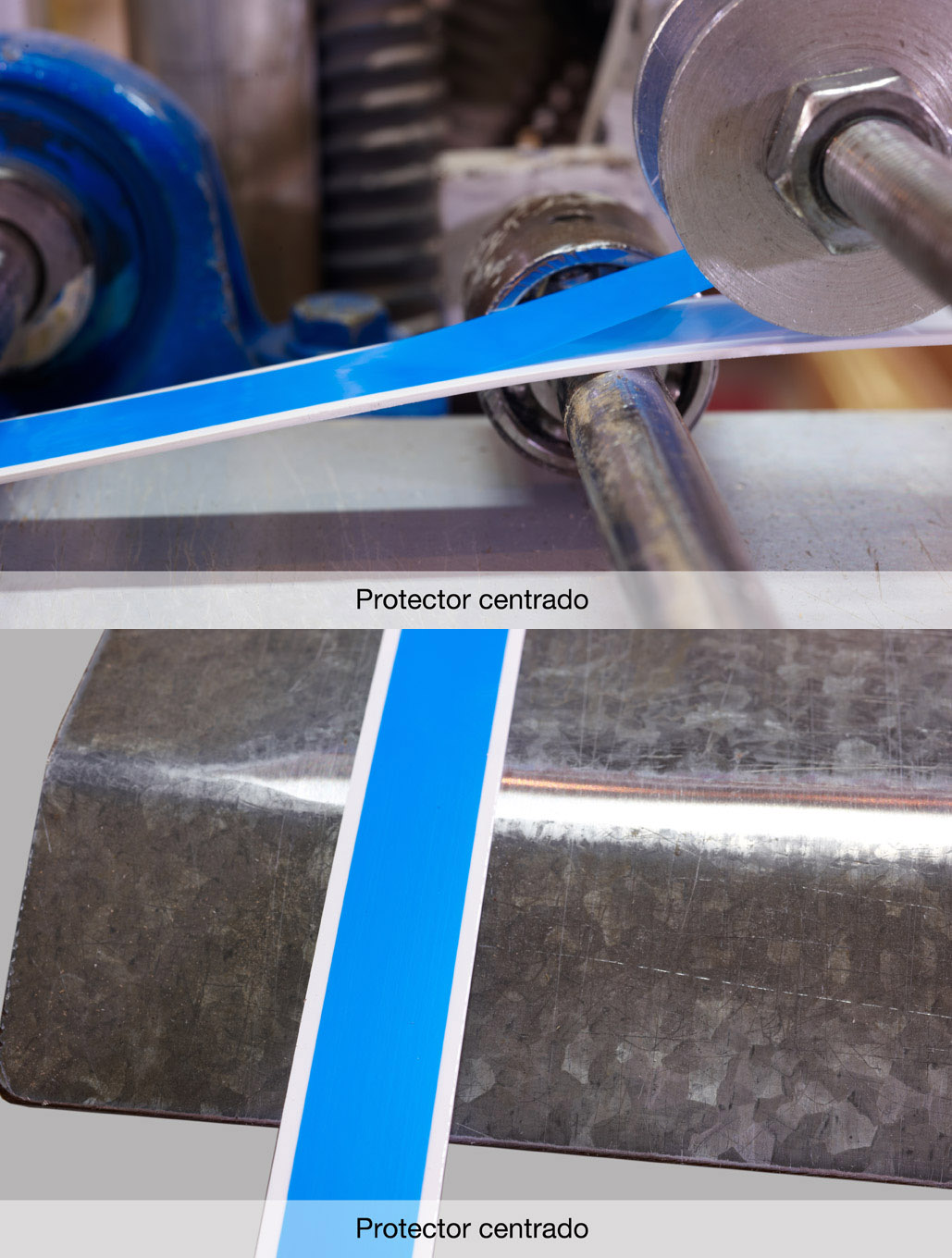
For special cases, where the edgebanding film is a problem (when profiling the edge on the edgebander), we can cover only the central part of the edgebanding film (centred edgebanding film).

Protective film

Textures and embossings

Following the latest surface trends, we can offer different pores on PVC.

They imitate the same structures of the melamine finishes on the market.

The result is a better integration of board and edge.

NH5_5882

Textures and embossings

Varnish (+ antibacterial)

Our wood-grain design ABS edges are UV lacquered to ensure a flawless sealing of the surface, thus covering the printed ink design, which will remain perfectly adhered and protected to the base. We copy the gloss level of the melamine board, so that the surface of the board and the edge are homogeneous.

Our PVC wood design edges are coated with a UV varnish, suitable for sealing the surface. In this way, we cover the printing ink, which is perfectly adhered to the base and protected.

The resistance of the varnish must be adequate for the normal wear and tear of a piece of furniture.

Antibacterial finish

The antibacterial finish is applied as a varnish on the edge surface. The silver ions in the finish adhere to the cell wall and disrupt bacterial growth. It is proven to provide permanent protection 24 hours after application. This process causes a bacterial reduction of up to 99% in less than 24 hours. The effectiveness of the product is guaranteed as long as the top coat is not removed, for example by sanding.

Download information document

Varnish (+ antibacterial)

High gloss varnish

In line with surface trends, high gloss edges are available. High-gloss furniture provides more space thanks to the brightness and reflections it creates.

To achieve the high gloss edge we use UV varnishes and Reverse application systems. With this procedure we achieve a gloss between 80 and 90 gloss. Both in unicolour and wood designs.

Request sample book >>

High gloss varnish

Supermatt varnish

Matt furniture makes the room stylish and rejuvenating. In line with surface trends, we have developed the edge with a super-matt finish. To achieve the perfect result it is important to get the matt finish also on the edge.

With UV varnishes, we achieve matt finishes between 4 and 6 gloss. We can apply them in both unicolour and wood designs.

Request sample book >>

Supermatt varnish

Proceso de fabricación

C/ Pintor Joaquín Sorolla Nº8
Polígono industrial Ciudad Mudeco

46930 Quart de Poblet Valencia, España

2024 Cantisa S.A.U.

cantisa@cantisa.es

(+34) 960 26 60 80

SUBSCRIBE TO NEWSLETTER

Legal notice and terms of use

Equality Plan

Complaints channel