For the production of veneer rolls for wrapping mouldings, we use the highest-quality materials. Our professionals select the wood veneer according to colour tones and quality.
At Cantisa, we manufacture continuous wood veneer rolls. Using this type of veneer increases working speed. In addition, it eliminates the need to prepare veneer strips according to the length of the moulding to be wrapped. Veneer in rolls allows pieces of different lengths to be wrapped.
Our veneer rolls are manufactured without joints or interruptions, ensuring maximum productivity during the moulding wrapping process.
Finally, once manufactured, the rolls are wrapped in plastic film to preserve the qualities of the wood.
Do you want to know more about this product?
For profile wrapping, we can supply fixed lenght strips instead of rolls.
For most wood species, only straight-grained veneers are accepted. We believe this criterion is the most suitable for moulding wrapping. Rolls with straight grain provide a more homogeneous appearance when creating furniture or interior designs. They also better conceal the joints between the veneer sheets that make up the roll.
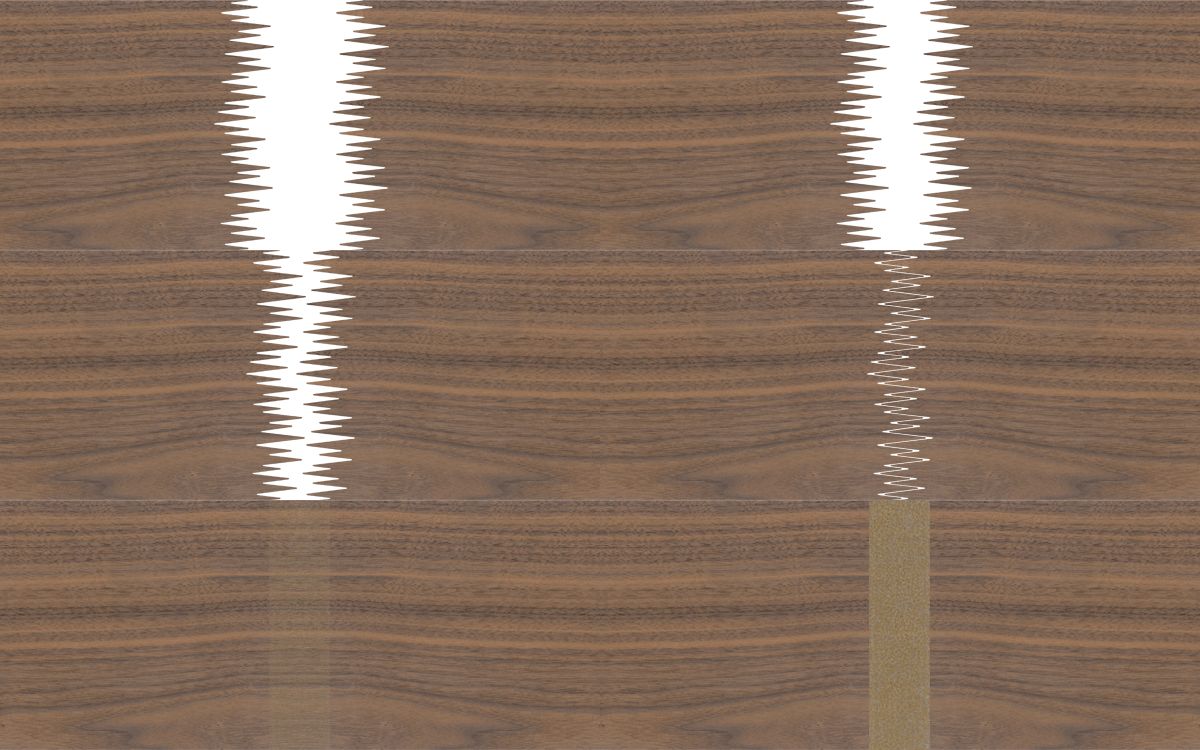
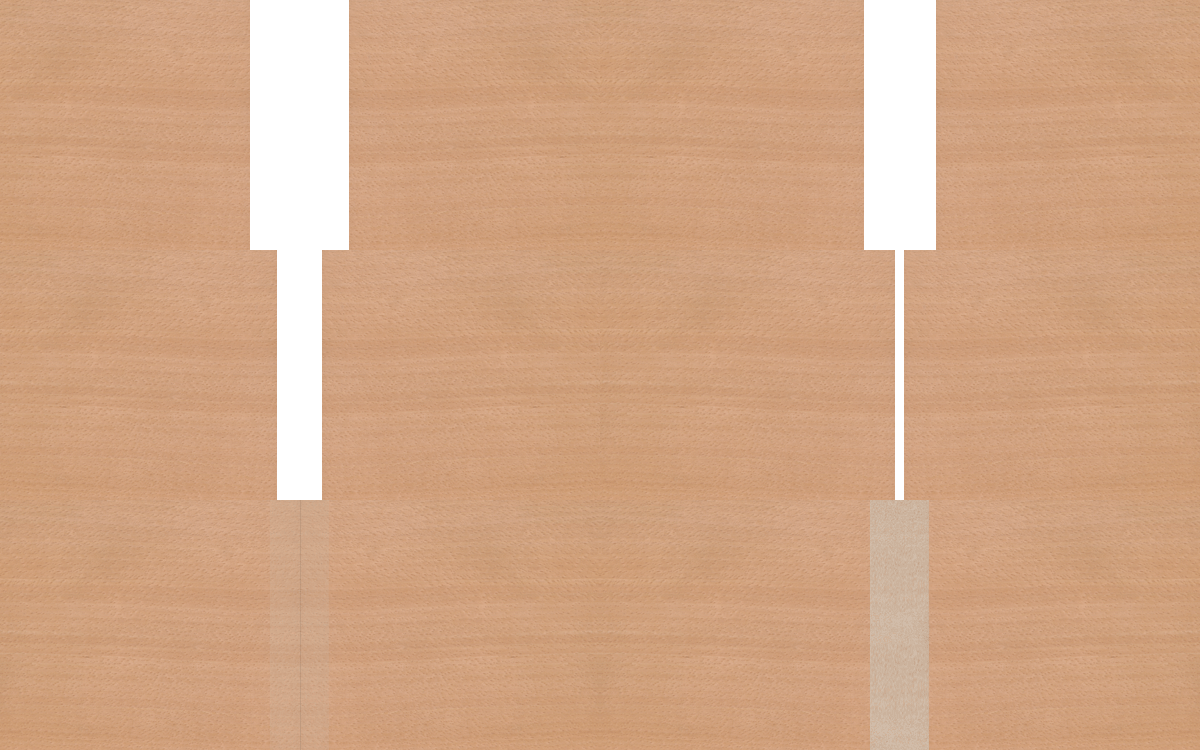
The joining of the end edges between veneer sheets for roll production is carried out using an irregular zig-zag pattern. This type of joint conceals the connection and is reinforced on the back with a strong fabric.
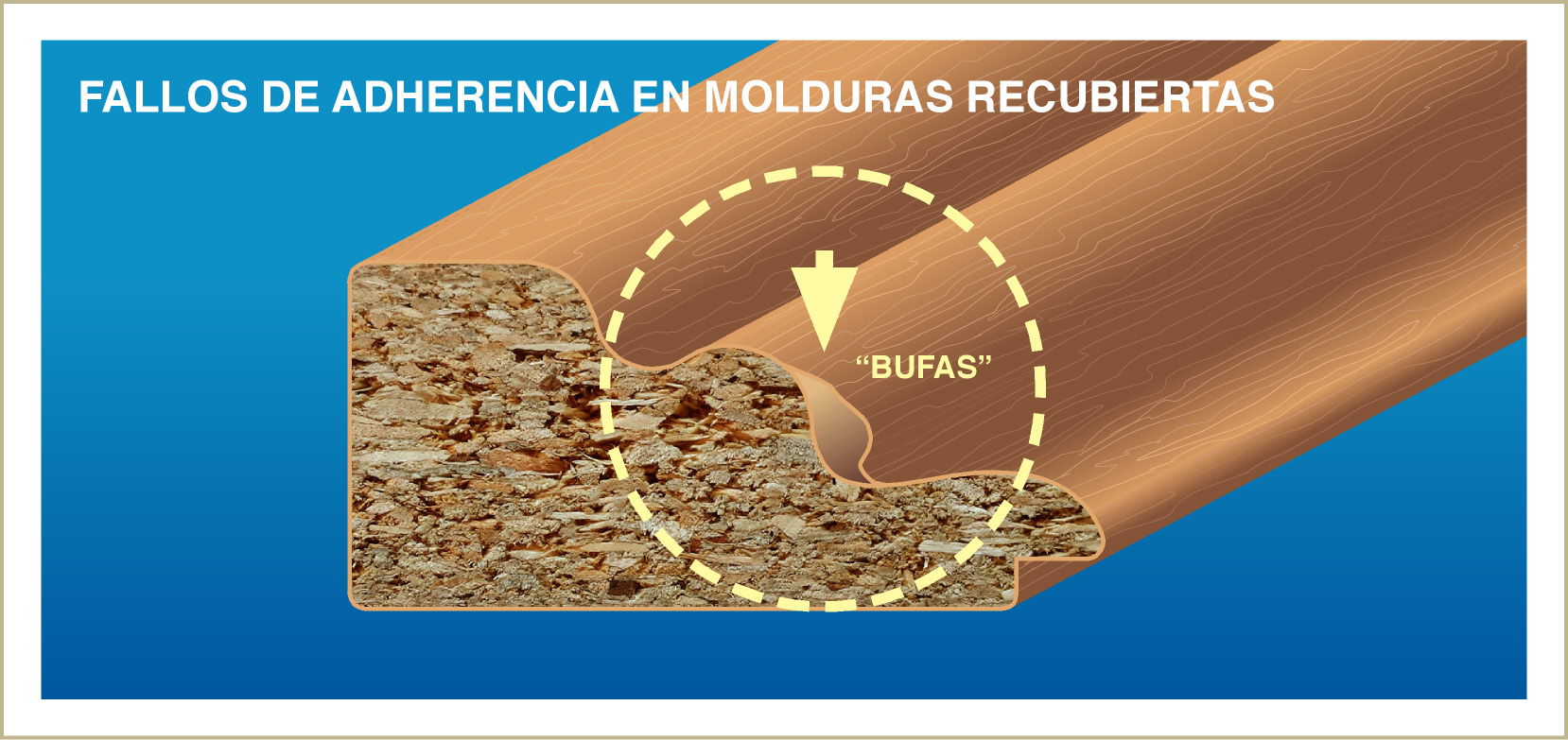
The sheets that have some corrugation are pressed to avoid problems of deviations. It also avoids the occurrence of “buffers” in the moulding trims.
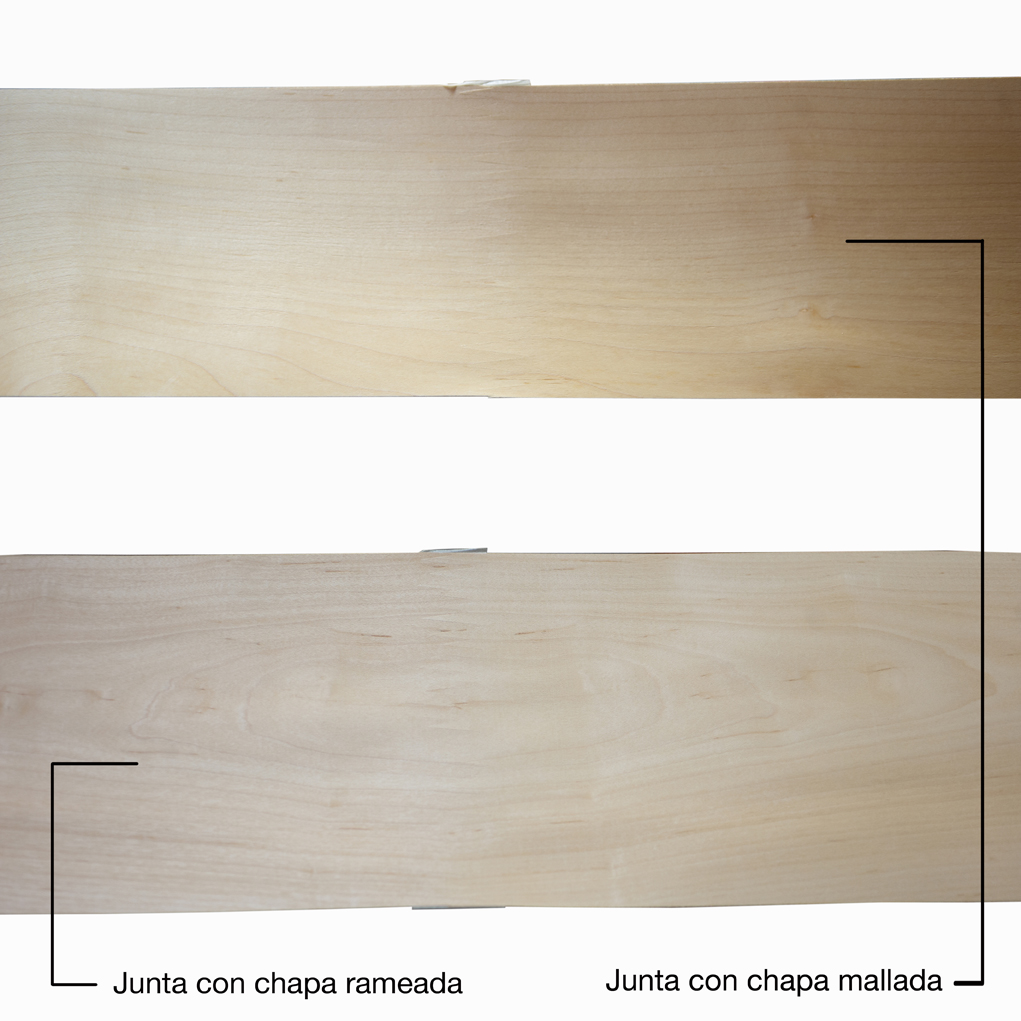
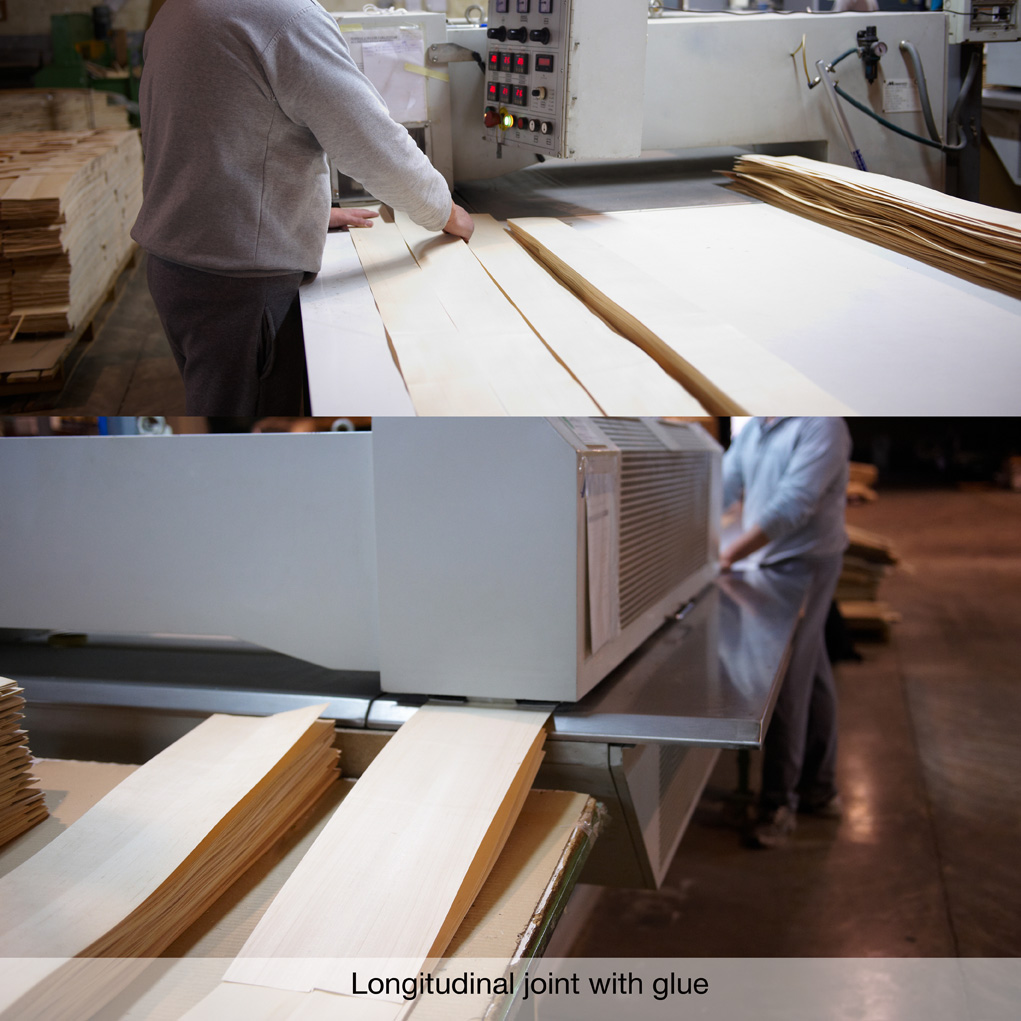
When the profile to be wrapped has a wide development and straight-grained veneer is required, we offer longitudinal edge joining with adhesive. This allows us to produce wider straight-grained veneer sheets that would otherwise not be possible.
The traditional moulding wrapping process consists of feeding the profile to be veneered into the machine from one side. The veneer sheet that will wrap the profile is fed in from the other side.
For this reason, using our continuous veneer rolls increases production speed. In addition, it eliminates the need to prepare veneer sheets to match the length of the moulding being wrapped. Since the veneer is supplied in rolls, pieces of different lengths can be wrapped.
All our wood products come from sustainably managed forests: View our FSC documentation here.
They also have the Phytosanitary Certificate for wood products.
Be inspired!
Visit our Pinterest and discover new decorative ideas. Enter our Pinterest and discover new ideas to decorate your melamine boards.
Natural/Raw
Natural/Raw
Fixed Length
For special applications, and at the customer’s request, we can join veneer sheets of a determined length in order to foresee where the joint will show once applied to the board.
The joint between veneers sheets can be:
Zig-Zag / Finger Joint (closed)
Straight joint / Butt joint (open)
The result being that the joint will not be visible.
If the BUTT JOINT it’s choosen, we can supply veneer rolls for profile wrapping with a induction readable aluminium tape, suitable only for special detection units. Resulting pieces will not have any joints.
Fixed Length
Soft Sanding and Calibrated Sanding
Soft Sanding
On the outside of the coil, we can apply a sanding, thus avoiding the work of sanding it by the customer and its level of finish will be much higher than that of a manual sanding.
The surface of the wood is perfectly prepared and without scratches, to continue the subsequent finishing processes (stain, primer, etc…).
When sanding on the veneer sheet, it is advisable that it has a fleece on the back side to give it more consistency.
Technical details of the process >>
Sanding – calibration (with stand)
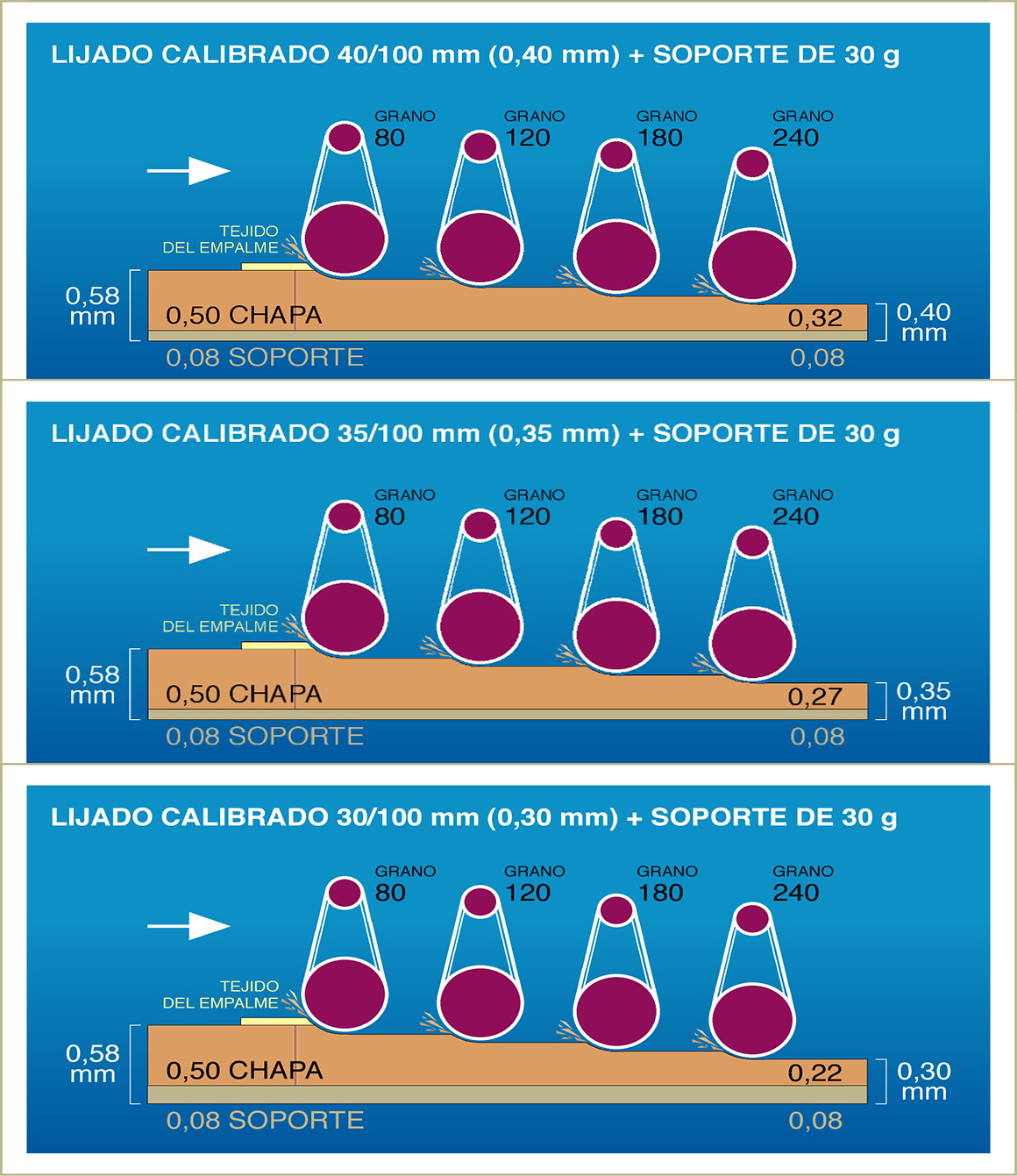
For special jobs, we reduce the thickness of the wood by sanding-calibration. This results in a more flexible sheet that bends without cracking and can be adapted to small bending radii.
The maximum thickness would be 0.40 mm (40/100 mm) and the minimum 0.30 mm (30/100 mm).
The back fabric, which supports the zig-zag joint, was removed so as not to find any steps that would make the joint more visible.
Thickness reduction on request (40-35-30/100 mm)
To apply a calibrated finish to the veneer, it must have a backing on its reverse side.
Under Technical details, you can find examples of supported veneer applications and different types of sanding.
Technical details of the process >>
The surface of the wood is perfectly prepared and without scratches, to continue the subsequent finishing processes (stain, primer, etc…).
Soft Sanding and Calibrated Sanding
Fleece Backed Edging
The backing is a non-woven fabric applied to the back of the veneer roll. This fabric is bonded to the wood using one of two types of adhesive:
PVA glue (white glue): with different degrees of moisture resistance (D3 and D4).
PUR glue (polyurethane): for the most demanding jobs against humidity.
With weaving we achieve two things:
The tone of the backing is chosen to match the tone of the veneer used, thus ensuring that the fabric is unnoticed by the possible transparencies of the veneer. The holder is compatible with EVA and PUR glues.
The 30-gram holders are the most common. We have different types of fabrics depending on their weight. The more grams the fabric has, the more consistency and flexibility it adds to the veneer, and we have different types of fabrics depending on their grammage. The more we reduce the thickness of the sheet, the more flexible it is:
30 grams backing (in beige, dark brown and black).
50-gram backing (beige).
Fleece Backed Edging
Varnish Options
We offer every possibility of varnishing on coils to cover mouldings. It is essential that we add 30 gr backing on the back in order to be able to properly varnish the veneer. Using UV varnishes, we can distinguish:
Sanded + Ground Lacquered
Sheet ready to receive the customer’s finishing varnish product.
If the product has been in storage for several weeks, it is advisable to sand it lightly before applying the finishing varnish, thus opening the pore of the base to improve the anchorage.
At the customer’s request, we can supply the anchoring with a more open or more closed pore.
For special jobs where the sheet has to be adapted to profiles with angles, options with more flexible UV backgrounds are available.
It is always necessary to test our product to see if it is flexible enough to coat the profile without cracking.
Technical details of the process >>
Clear Varnish
Pre-finished veneer with a varnish coating.
Depending on our customers’ indications, we can work with open or closed pores, depending on the wood species to be treated.
The gloss levels are adjustable and are measured with a gloss meter to match the gloss of the board surface to be copied (from matt 8 to gloss 80).
It is always necessary to send us a sample of your varnished surface board in order for us to carry out our work better.
For special jobs where the sheet has to be adapted to profiles with angles, options with more flexible UV backgrounds are available.
It is always necessary to test our product to see if it is flexible enough to coat the profile without cracking.
Technical details of the process >>
Colour, pore and gloss finish varnishing
Finished veneer with varnish, tone and pore, perfectly finished.
This product is highly personalised and in each case the type of finish required is assessed with the customer.
Closed pore finishes may require several coats of primer, depending on the porosity of the sheet used.
The gloss levels are adjustable and are measured with a gloss meter to match the gloss of the board surface to be copied (from matt 8 to gloss 80).
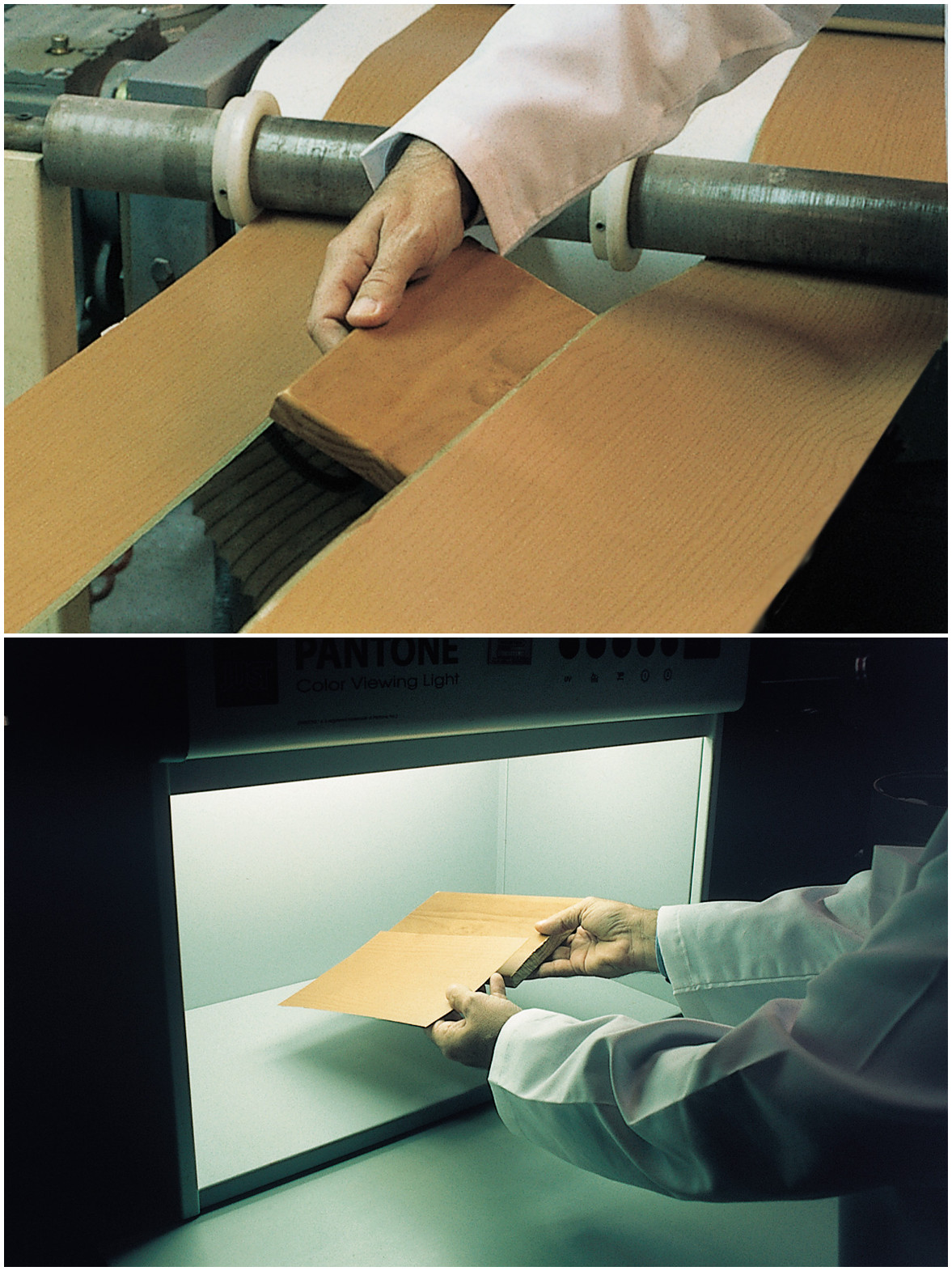
Our colourists copy the tone of its finished part and the degree of gloss of the part.
El color de las producciones de canto, se comparan con el tablero a copiar dentro de la cámara de colores utilizando luz día.
Para trabajos especiales en los que la chapa ha de adaptarse a perfiles con ángulos, disponemos de opciones con fondos UV más flexibles.
Es necesario siempre una prueba de nuestro producto para ver si tiene la flexibilidad suficiente para recubrir el perfil sin quebrarse.
No dude en ponerse en contacto con nuestro departamento técnico para aclarar cualquier información.
It is essential that you send us a sample of your finished piece in order to be able to make a successful copy.
Technical details of the process > >
> Special finish: patina effect on wood
We introduce into the grain of the wood a stain that can be of different colours, achieving a rustic wood effect. With this special finish, the grain pattern is clearly enhanced. See black patina effect finish.
To add flexibility to the veneer and to protect it in the process of coating the moulding, we can add a protective plastic.
Varnish Options
Protective film
On the outside of the sheet we can apply a low-adhesive protective plastic. This option makes sense for coils that are already varnished and finished.
Plastic has three functions:
Protective film
Natural species
Madera natural en láminas (chapas) de 0,5 – 0,6 mm de espesor.
Podemos producir con cualquiera de las especies disponibles en el mercado.(Ver ejemplos).
Proceso de obtención de la chapa de madera:
Natural species
Fineline Veneers
Wood veneer sheets with a thickness of 0.5–0.6 mm.
Reconstituted veneers are cost-effective natural wood veneers that undergo a carefully controlled process. The veneers are dyed to the desired colour, pressed together into a block, and then sliced into sheets to create the required grain pattern.
We can manufacture using any wood species available on the market. See examples.
The fineline or reconstituted veneer is a thin veneer sheet obtained through a lamination process beginning at the edge of a veneer block, thus obtaining a perfectly homogeneous or straight grain. While manipulating the contour of the sheets to be pressed, various configurations and very attractive aspects are obtained.
Some or all the sheets can be dyed before joining them, so as to create astonishing aspects and colours .
Production process:
Fineline Veneers
Dyed veneers
Dyed veneers are obtained when natural veneer sheets are immersed in a staining solution, which penetrates to the core of the veneer. The entire thickness of the sheet (up to the center) is tinted.
This process enables to vary the veneer’s natural colours resulting in:
We can produce edge banding with any of the available species on the market, and obtain the customer’s required tone.
0,5 – 0,6 mm thick natural veneer sheets.
Dyed veneers
Solid End-Grain Edgebanding
Wood veneers are obtained through a special cross-section cut of the log.
These veneers are round, and their length and width correspond to the log’s diameter.
Thus, all the tree’s growth rings can be visualized.
The standard thickness is 0.7 mm, but from this veneer, thicker edge bands can be made.
Solid End-Grain Edgebanding
Burl and veneer roots
A burl is a tree growth in which the grain has grown in a deformed manner. Unknown as to how this deformity develops on a log, it features an irregular pattern opposed to a smooth lineal aspect. Veneer burls are both present underground or at surface level of the tree trunk. It is commonly found in the form of a rounded outgrowth on a tree trunk or branch.
We can produce with any of the species available on the market.
Burl and veneer roots
Thermo-treated, smoked and aged veneers
Natural wood veneers focused on special decorations due to their exclusivity. It is the resulting reaction of veneer to paper products, enhancing its originality, warmth and distinction, attributes that cannot be copy with printed paper.
We can distinguish the following variations of natural veneers:
Thermo-treated veneers:
It is applied a 100% natural process applied in order to modify the original wood colour, without intervention of any chemical element 100% natural, without the intervention of any chemical process or element. Sustainability of the colour, as it does not contain any type of dye that could react differently to UV light and therefore generate changes in shade.
Smoked (Fumé) Veneers
Aesthetically, it is a natural veneer which features a smoked look, shinny and enhanced by a 3D effect, maintaining live stripes and highlighting the aspect of each log.
The smoked is a treatment based on the reaction of the veneer natural tannins to different chemical agents which change the original colour of the veneer without loosing its natural look. During the smoking process, the chemical elements are neutralized, thus ensuring a 100% natural PH product.
Aged Veneers
This accelerated process has the purpose of featuring a natural aged aspect to the veneer when exposed outdoors. Grey tones which do not follow a set pattern are thus obtained, transferring to the final product a look of aged wood due to sun and weather exposition.
Especially suitable for a rustic touch, cracked, with knots, releasing a unique and different look. Most appropriate product for interior decoration purposes. Application examples:
Thermo-treated, smoked and aged veneers
Sawcut Veneer
Following latest trends, we offer the rustic look of saw cut veneer. We offer nature-saw-cut in the most common veneers on the market.
Deep transversal print embossed in such a way that some prints stand out while others are embedded. Two different types of prints can be visualized, depending on the inclination:
Standard thickness is 0,7 mm, but superior thicknesses can be produced. The visual effect is eye catching and enables a wide range of design applications.
Sawcut Veneer
Printed veneer
For special edge and moulding applications, a grain design can be printed over a different veneer.
Using more economical species as a base, we can print the natural pattern or design of highly valued veneers with a matching tone. Just imagine a low cost veneer such as okume, over which we will print the grain and tone of, let us say, Rosewood Rio or Makassar Ebony. As the base of the product is authentic veneer, the touch and pore of the product will transfer the sensation of the natural pattern.
Thanks to our printing technique we can obtain quarter cut patterns which prove to be difficult to find in extra wide formats (for example, 20 cms).
Printed veneer
Elaboration of customer’s veneer